Connect with Bon

WHINE Kindle US

Image of When Hope is Not Enough
When Hope is Not Enough
WHINE now available on the Kindle to US customers!

Buy WHINE Today!

Image of When Hope is Not Enough
When Hope is Not Enough
Get the Non-BPD book that is designed for
staying and working on the relationship

Poll

What do you do to support your emotional health?

View Results

Loading ... Loading ...

A free eBook – 4X4 for Nons

Here is a free eBook from Bon: Free eBook

Archives

Mindfulness and Acceptance

I found this in the Amazon blog of the guy who was the editor of the
Mindfulness and Acceptance book…

(snip)
Acceptance, mindfulness, values – how do we use them in dealing with
our emotions? We need to:

Learn to accept our feelings, without being dictated to by them and
without quickly acting to remove ones we do not like. Trying to get
rid of feelings only drives them underground, while simultaneously
giving them more capacity to control behavior without our awareness.
Acceptance of emotion requires another step, however.

Learn to watch our thoughts, without reflexively adopting the
worldview mindlessly structured by them. Thoughts are easily
programmed, and they are nothing to be right about – or wrong about.
They are just thoughts. Some of those thoughts will not be attractive,
because they are constantly being programmed by sources we do not
control. We will hear in our own minds the echoes of judgment, bias or
prejudice to which we are exposed nearly every day.

The point is not to “feel bad” about the existence of such thoughts in
our heads, nor to feel self-righteous about the thoughts that we agree
with – the point is to be more conscious, open and flexible in how we
translate thoughts into action. Knowing how to do that requires a
final step.

While staying aware of our feelings and thoughts, make mindful choices
about what we’ll actually do based on chosen values. Our emotions are
a legacy of our entire development as a species, and our thoughts are
an echo of our history. Fear, anger and desire are part of the human
condition. They can sensitize us to what is going on in the moment -
but we have to learn how to have them without being had by them.

The emotional imperative of “now” is just too automatic and mindless
to be trusted. We need to learn to be guided by our values and
choices, not just our emotional and cognitive programming. Human
beings are the only animals who can interpose mindful awareness and
values-based choice between urges and actions. Now, more than ever,
that is what we need.

If we do not learn how to be wiser, we have a difficult road ahead of
us as a species: expanding waistlines and expanding hate; indulgence
and suppression; rigidity and loss of control. Feel-goodism meets the
technologically expanded capacity for dehumanization. All linked to
the demand to change the emotion now.

We are conscious beings riding in a primitive emotional vehicle
programmed for another day and time. That vehicle is careering down a
mountain road with only a prayer to save us. Unless we learn to drive.
(unsnip)

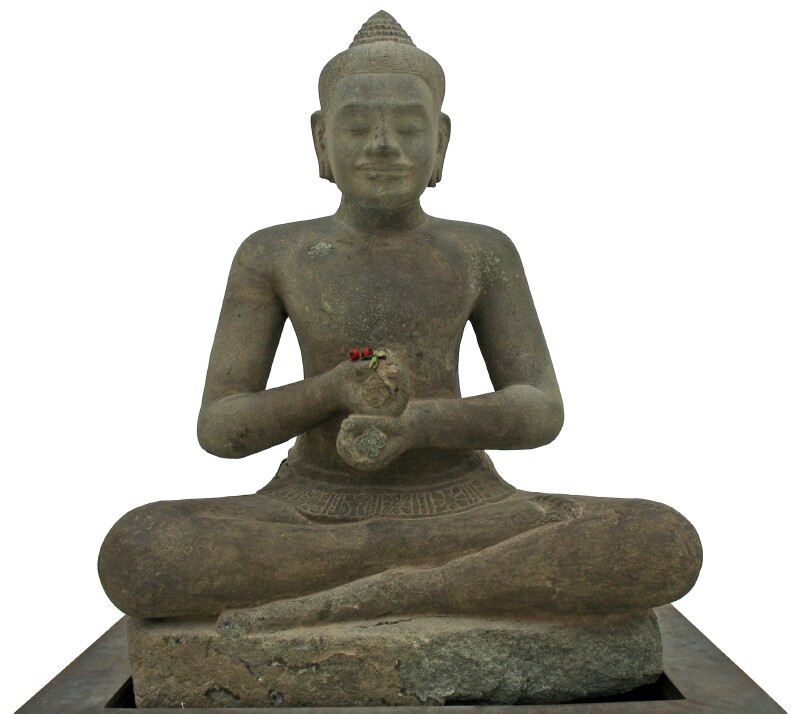
Buddha and DBT

It is CBT, but focuses on schemas and deeply-entrenced “cognitions”.
Unlike DBT, which focuses on emotions (mainly) and cognitive
distortions, SFT takes a page from the personality people and tries to
rebuild the schemas that make up the personality. DBT is usually not
too concerned with “what you learned from your parents” more “what you
think about things and how can we change that”.
Now, with respect to a Jospeh Campbell thing – I could say quite a
bit. What I’d like to say is this (hopefully briefly, because I’m busy
today – I have read all the messages from yesterday and before and
there seems to be a bunch of stuff going on in everyone’s lives. I also
want to post another message about my daughter who is having some
serious emotional issues):

There are at least three ways of looking at the universe (and it’s
interaction with our minds). They are basically this:
1) The western way (or the “clockwork universe”). Because rationality,
science and technology is so ingrained in our way of thinking the model
of the universe is that of a giant mechanism. We (or bodies) are also
mechanisms. The mind/spirit/soul/self is some kind of “ghost in the
machine” – living inside it’s machine skin and going on after death to
another realm.
2) The Indian way (or “all the world’s a stage”). Every person and
thing is a hiding place for god – he (or the ultimate spirit – the pure
brahma – ok my spelling will be crappy and I don’t have time to look it
up) is reflected in you (in “your” ultimate spirit called “atman” in
sanskrit). God wears a “you” mask and a “me” mask. Basically, (in
computer terms) we are all particular instances of a class called
“spirit”. That is the “true” reality, the rest is illusion (maya). This
grew out of the society (which, with it’s caste system is very
role-based). However, Buddhist thought shattered that world-view (more
on that later).
3) The Chinese way. (or “organic systems” – in Chinese I think it’s
called Wu-Li). The universe and you are a tightly integrated organic
engery system. You are a natural extension of the world and the world
is a natural extenion of you. You can not exist without the world, it
can not exist without you. Think of the Yin-Yang and that symbol sort
of summarizes this position.

As Buddhism integrated Chinese concepts #2 and #3 sort of merged and
mixed. Buddha, however, pretty much dismissed “atman” (or essential
essence, see below).

OK, on the Buddhist thing. Buddha espoused three core concepts (called
the 3 “marks of existence” – he BTW had a lot of lists of ideas. Why?
because these ideas were not written down for hundreds of years, so the
monk had to remember them.) – they are:
1) Dukkha – suffering. Suffering exists and it exists because of a
basic inability of the mind to accept the state that it is actually in.
We thrist for “other” and cling to what we think we “have” (including,
paradoxically, our own mind).
2) Anicca – impermance. Every thing is in a state of flux, passing in
and out of existence, including ourselves and our minds. There is a
really interesting related concept called “Dependent Arising” (although
there are a number of translations of it). I don’t have time to talk
about that, but it is facisnating (and implies there is no creator of
the universe or beginning at all, BTW).
3) (OK here is the biggy in the Joseph Campbell sense) Anatta means
“no-self”. Buddha didn’t believe that we had a “core”
personality/mind/identity. This concept is that the mind (or self) is
made up of five “bundles”. A quote from the buddhism scripture (written
long after buddha died BTW):

“A chariot is neither asserted to be other than its parts, nor to be
non-other. It does not possess them. It does not depend on the parts,
and the parts do not depend on it. It is neither the mere collection of
the parts, nor it is their shape.:

Basically, we created the “charriot” in our minds and call it “me”. But
it is made up of parts that, on their own, can’t be called a charriot.
It is a concept that we label something with wheels and a seat and a
place for horses to pull (or race in like “Ben-hur”). But it is nothing
more than a label we slap on that concept. Buddha was suggesting that
our identity is the same way. There is no “you” there. Instead there is
a flux of feelings, thoughts, memories, sensory perceptions (or
“cognitions” – mental floral and fauna) that you throw together, slap
your name on it and say “hey that’s me!” However, are you the same you
as you were at 9 years old?

What does any of this have to do with BPD? Actually, probably a LOT. If
they feel that they have no core – they, according to the Buddha
anyway, might be experiencing reality as is really is. But it scares
the living sh*t out of them. Like doing acid? I think
it is probably a whole lot like doing acid. Nothing to stand on,
nothing to build on. You can’t build a castle on top of a river.

So, DBT borrowed more from Buddhism than mindfulness – it also borrowed
the concept of radical acceptance – deep acceptance and knowing of the
way things REALLY are. If you can’t accept it, if you cling to that
illusion, if you feel that your mental afflictions are real, then you
are in for a whole lot of suffering (see “mark of existence #1″). But
the interesting things is: what if our BP’s are actually MORE sensitive
to the “actual” reality than we are? Sure, it’s scary, but it might be
more “real”? That, of course, only applies to their sense of “self”,
not the impulsiveness and the emotional dysregulation. I think there
was a psychologist that called schizophrenics “the hyper-sane” (but I
think he became a Scientologist and disavowed psychiatric meds and
stuff). Something to think about.

Anyway, that was fun. As you know I find Buddhist thought/philosophy
very interesting.

BF Skinner meets Buddha with DBT

An article about DBT:

Underlying this skills-based approach is Dr. Linehan’s belief that borderline individuals are deficient in emotion management skills. According to her bio-social theory, borderline personality disorder results from a biologically based emotional vulnerability (high sensitivity, high reactivity, and a slow return to baseline) in combination with environmental factors that invalidate emotions over time and thwart the use of skills. This is a controversial departure from the psychoanalytic community’s view of borderlines as deficient in personality structure and personality functioning. In fact, Dr. Linehan advocates a name change for the much maligned borderline diagnosis, proposing instead the label of “”emotion dysregulation disorder”" and a reorganization of diagnostic criteria.

http://www.groupsinc.org/pubs/GC_0402_skinner.html

Blaming Never Helps

From “”Peace is Every Step”" by Thich Nhat Hanh:

When you plant lettuce, if it does not grow well, you donít blame the lettuce. You look into the reasons it is not doing well. It may need fertilizer, or more water, or less sun. You never blame the lettuce. Yet if we have problems with our friends or our family, we blame the other person. But if we know how to take care of them, they will grow well, like lettuce. Blaming has no positive effect at all, nor does trying to persuade using reason and arguments. That is my experience. No blame, no reasoning, no argument, just understanding. If you understand, and you show that you understand, you can love, and the situation will change. One day in Paris, I gave a lecture about not blaming the lettuce. After the talk, I was doing walking meditation by myself, and when I turned the corner of a building, I overheard an eight-year-old girl telling her mother, “”Mommy, remember to water me. I am your lettuce.”" I was so pleased that she had understood my point completely. Then I heard her mother reply, “”Yes, my daughter, and I am your lettuce also. So please donít forget to water me too.”" Mother and daughter practicing together, it was very beautiful.